
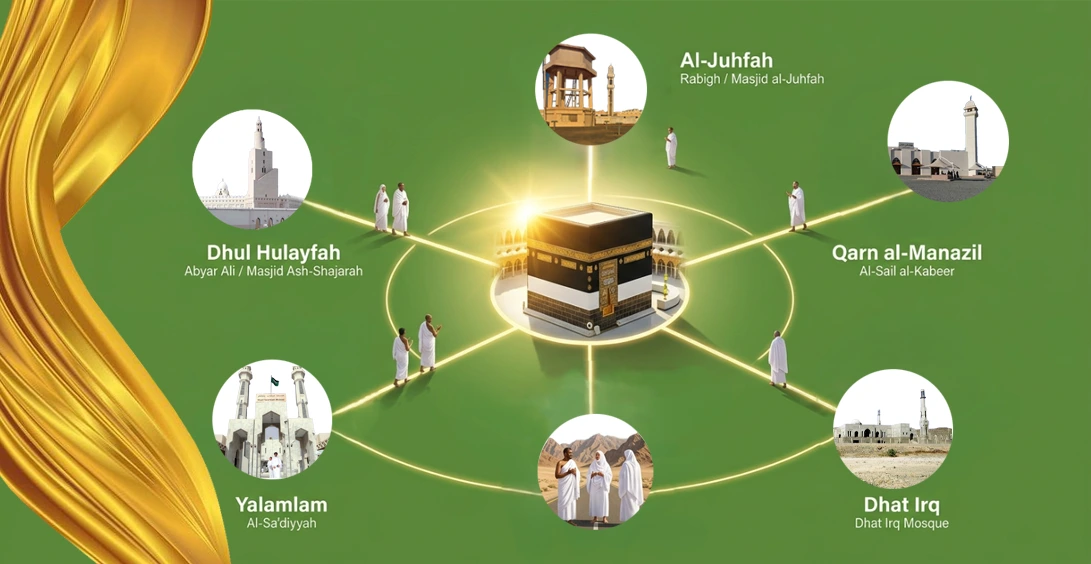
Miqat points are 5 designated geographical boundaries established by Prophet Muhammad ﷺ, recorded in Sahih al-Bukhari (Book 25, Hadith 1), where every pilgrim must enter the state of Ihram before crossing into the sacred precinct of Makkah for Hajj or Umrah.
The 5 primary Miqat locations in Saudi Arabia are Dhul Hulayfah, Al-Juhfah, Qarn al-Manazil, Yalamlam, and Dhat Irq. Each Miqat serves pilgrims approaching Makkah from a specific direction. Makkah residents and repeat Umrah pilgrims use 6 local Miqat points within the Al-Hill zone, the nearest being Masjid Aisha at 7–8 km from Masjid al-Haram.
“Allah’s Messenger ﷺ had fixed Dhul Hulayfah as the Miqat for the people of Madinah; al-Juhfah for the people of Sham; and Qarn al-Manazil for the people of Najd; and Yalamlam for the people of Yemen. These are the Mawaqit for all those living in those places, and besides them for those who come through those places with the intention of performing Hajj and Umrah.”
What Are the Two Types of Miqat in Islam?
Islam defines 2 types of Miqat — Miqat Zamani (time boundary) and Miqat Makani (spatial boundary). Both govern when and where pilgrims enter the state of Ihram for Hajj or Umrah.
- Miqat Zamani (ميقات زماني) — Time Boundary: Hajj performs within 3 designated months — Shawwal, Dhul-Qadah, and the first 10 days of Dhul-Hijjah. Umrah performs any month of the Islamic calendar year.
- Miqat Makani (ميقات مكاني) — Spatial Boundary: The 5 fixed geographical stations around Makkah, established by Prophet Muhammad ﷺ, where Ihram begins before entering the sacred precinct. A sixth station — Dhat Irq — was added by Caliph Umar ibn al-Khattab (RA) for pilgrims from Iraq and Persia.
What Are the Three Sacred Zones Around Makkah?
Islamic jurisprudence divides the land surrounding Makkah into 3 sacred zones Al-Haram, Al-Hill, and Afaq each carrying distinct Ihram obligations for pilgrims and residents.
The table below defines all 3 zones by boundary, location, and Ihram rule for pilgrims and residents.
| Zone | Arabic | Boundary | Examples | Ihram Rule |
|---|---|---|---|---|
| Al-Haram | الحرم | Innermost sacred precinct of Makkah | Masjid al-Haram, Kaaba, Makkah city | Residents intending Umrah must exit to Al-Hill before assuming Ihram |
| Al-Hill | الحِل | Between Haram boundary and outer Miqat stations | Jeddah, Tan’eem, Ji’ranah, Hudaibiyah | Residents assume Ihram from their home before crossing into Haram |
| Afaq | الآفاق | All land beyond the 5 outer Miqat boundaries | Pakistan, Egypt, UK, Indonesia, Nigeria | Pilgrims (Afaqi) assume Ihram at whichever of the 5 primary Miqat stations they reach first |
Al-Hill includes Jeddah confirming that Jeddah lies inside the Miqat zone, not at the boundary, which is why Jeddah does not serve as a Miqat for international pilgrims.
What Are the 5 Primary Miqat Points in Saudi Arabia?
Saudi Arabia has 5 primary Miqat points Dhul Hulayfah, Al-Juhfah, Qarn al-Manazil, Yalamlam, and Dhat Irq. Prophet Muhammad ﷺ designated 4 of these Miqat locations. Caliph Umar ibn al-Khattab (RA) added Dhat Irq after the conquest of Basra and Kufa.
- Dhul Hulayfah: 450 km north of Makkah, designated for Madinah pilgrims and those visiting Madinah first.
- Al-Juhfah: 190 km northwest, designated for pilgrims from Syria, Egypt, Jordan, Turkey, North Africa, and Europe.
- Qarn al-Manazil: 80–90 km east, designated for pilgrims from Najd, UAE, Oman, Pakistan, Malaysia, and Australia.
- Yalamlam: 100 km south, designated for pilgrims from Yemen, India, South Africa, and Nigeria.
- Dhat Irq: 85–94 km northeast, designated for pilgrims from Iraq, Iran, China, and Russia.
The table below maps all 5 primary Miqat points by name, distance, direction, and the regions they serve for Hajj and Umrah.
| Miqat Name | Also Known As | Distance from Makkah | Direction | Pilgrims Served From | Designated By |
|---|---|---|---|---|---|
| Dhul Hulayfah | Abyar Ali · Masjid As-Shajarah | 450 km | North | Madinah, North America, Europe (via Madinah) | Prophet Muhammad ﷺ |
| Al-Juhfah | Rabigh · Masjid al-Juhfah | 190 km | Northwest | Syria, Egypt, Jordan, Turkey, North Africa, Europe, North America (direct) | Prophet Muhammad ﷺ |
| Qarn al-Manazil | Al-Sail al-Kabeer · As-Sail al-Kabiir | 80–90 km | East | Najd, Riyadh, UAE, Oman, Kuwait, Bahrain, Qatar, Pakistan, Malaysia, Australia | Prophet Muhammad ﷺ |
| Yalamlam | Al-Sa’diyyah · Al-Sadiah | 100 km | South | Yemen, India, Pakistan, Bangladesh, Indonesia, South Africa, Nigeria | Prophet Muhammad ﷺ |
| Dhat Irq | Dhat Irq Mosque · Irq Aswad area | 85–94 km | Northeast | Iraq, Iran, China, Russia, Central Asia | Caliph Umar ibn al-Khattab (RA) |
The correct Miqat for any pilgrim depends on the direction of travel, not nationality. A pilgrim from the UK visiting Madinah first uses Dhul Hulayfah. The same pilgrim flying directly to Jeddah crosses Al-Juhfah from the air.
What Is Dhul Hulayfah Miqat (Abyar Ali)?
Dhul Hulayfah is the farthest Miqat from Makkah at 450 km, located 9 km southwest of Masjid an-Nabawi in Madinah. Dhul Hulayfah serves pilgrims from Madinah and those approaching Makkah from the north, including many North American and European pilgrims who visit Madinah before Makkah.
Dhul Hulayfah holds the distinction of being the starting point of the Farewell Pilgrimage of Prophet Muhammad ﷺ (10 AH / 632 CE). The large mosque at this location Masjid As-Shajarah (Mosque of the Tree) provides full Ihram facilities including showers, changing rooms, and ablution areas. The site is also called Abyar Ali by local residents.
What Is Al-Juhfah Miqat (Rabigh)?
Al-Juhfah is the Miqat located 190 km northwest of Makkah, designated for pilgrims arriving from Syria, Egypt, Jordan, Lebanon, Palestine, Turkey, and North Africa. Most pilgrims today assume Ihram at Rabigh, a town 15 km from the original Al-Juhfah site, where Masjid Miqat al-Juhfah built in 1306 Hijri provides full Ihram facilities.
Al-Juhfah carries historical significance: Prophet Muhammad ﷺ met his uncle Abbas ibn Abd al-Muttalib (RA) at Al-Juhfah during the Conquest of Makkah (8 AH / 630 CE). Pilgrims flying directly to Jeddah from Europe or North America cross this Miqat zone from the air and must be in Ihram before the crossing.
What Is Miqat Qarn al-Manazil (Al-Sail al-Kabeer)?
Qarn al-Manazil is the Miqat located 80–90 km east of Makkah near Taif, designated for pilgrims from Najd, UAE, Oman, Kuwait, Bahrain, Qatar, Pakistan, Malaysia, Australia, and Singapore. Qarn al-Manazil is also called Al-Sail al-Kabeer, the name of the valley at the base of the surrounding mountain terrain.
Angel Jibraeel (AS) appeared before Prophet Muhammad ﷺ at Qarn al-Manazil in the 10th year of the Prophethood, after the people of Taif rejected and persecuted the Prophet ﷺ. Jibraeel (AS) offered to destroy Taif, and the Prophet ﷺ refused, praying instead for the guidance of Taif’s descendants. The mountainous terrain surrounding this Miqat station requires pilgrims to assume Ihram before reaching the exact point.
What Is Yalamlam Miqat (Al-Sa’diyyah)?
Yalamlam is the Miqat located 100 km south of Makkah, designated for pilgrims from Yemen, India, Pakistan, Bangladesh, Indonesia, South Africa, and Nigeria. Yalamlam is also called Al-Sa’diyyah and historically served as the Miqat for Indian subcontinent merchants arriving by sea before commercial air travel.
Pilgrims flying from South Asia, Southeast Asia, and sub-Saharan Africa to Jeddah cross the Yalamlam Miqat zone from the air. Airlines on these routes typically broadcast an onboard announcement before the crossing. Pilgrims must be fully in Ihram before that announcement.
What Is Dhat Irq Miqat?
Dhat Irq is the Miqat located 85–94 km northeast of Makkah, designated for pilgrims from Iraq, Iran, China, Russia, and Central Asia. Caliph Umar ibn al-Khattab (RA) established Dhat Irq after the Muslim conquest of Basra and Kufa, when the people of those cities found it impractical to travel to Qarn al-Manazil. The name derives from the large mountain Irq Aswad in the area.
What Are the Miqat Points for Umrah in Makkah?
Makkah residents and pilgrims performing a second Umrah use 6 local Miqat points in the Al-Hill zone the nearest being Masjid Aisha (Tan’eem) at 7–8 km from Masjid al-Haram. Pilgrims already inside the Haram boundary must exit into Al-Hill before assuming Ihram, following the precedent established by Prophet Muhammad ﷺ when he instructed Aisha (RA) to go to Tan’eem.
The table below lists all 6 local Miqat points for Makkah residents and repeat Umrah pilgrims, with distance from the Kaaba and direction of each point.
| Miqat Location | Distance from Kaaba | Direction | Significance |
|---|---|---|---|
| Masjid Aisha (Tan’eem) | 7–8 km | North (Madinah road) | Nearest and most-visited; site where Aisha (RA) assumed Ihram by Prophet’s ﷺ instruction |
| Masjid al-Ji’ranah | 14–22 km | Northeast | Most virtuous local Miqat; Prophet ﷺ assumed Ihram here after Battle of Hunayn (8 AH) |
| Masjid al-Hudaibiyah (Al-Shumaisi) | 16–24 km | West (Jeddah road) | Site of the Treaty of Hudaibiyah (6 AH / 628 CE); described in Quran, Surah Al-Fath 48:1 |
| Adaat Laban | 11 km | South (Yemen road) | Less-used local boundary point; marks Haram edge on the southern route |
| Wadi Nakhla | 11 km | East (Iraq road) | Less-used local boundary point on the eastern route toward Iraq |
| Arafat — Masjid Nimra area | 11 km | East (Taif road) | Marks the Haram boundary on the Taif approach road |
Masjid Aisha (Tan’eem) handles the majority of repeat Umrah pilgrims due to its proximity to Masjid al-Haram and full transport links. Masjid al-Ji’ranah carries greater scholarly virtue due to the Prophetic precedent.
What Is Masjid Aisha Miqat for Makkah?
Masjid Aisha (Masjid al-Tan’eem) is the nearest Miqat from Makkah at 7–8 km from Masjid al-Haram, serving as the designated Ihram point for Makkah residents and all pilgrims performing a second or additional Umrah. Masjid Aisha is also called the Umrah Mosque and Masjid al-Tan’eem named after the two mountains flanking its location on the Makkah-Madinah Expressway (Tareeq al-Hijrah).
Aisha (RA) narrated: “I said, ‘O Rasulullah ﷺ! While you have performed Hajj and Umrah, I have performed only Hajj.’ He ﷺ told Abdur Rahman ibn Abi Bakr: ‘Leave the Haram with your sister and let her assume Ihram for Umrah.’ We reached Tan’eem where I started the Umrah.”
The Abbasid Caliph al-Mutawakkil built the original Masjid Aisha structure in 240 AH (854 CE) at the exact site of Aisha bint Abu Bakr’s (RA) Ihram during the Farewell Hajj (9 AH / 632 CE). The mosque has since been expanded and renovated to accommodate growing pilgrim numbers during Ramadan and Hajj seasons.
Facilities at Masjid Aisha include: separate halls for men and women, Ghusl (ritual bath) rooms, Ihram changing areas, ablution facilities, and surrounding shops selling Ihram garments, money belts, and slippers. Transport to Masjid Aisha from Masjid al-Haram runs via Bus No. 12 from Terminal 1, Jabal al-Ka’bah (4 riyals one-way, approximately 15–20 minutes). Taxis and ride-sharing services also operate this route around the clock.
How to Perform Umrah from Masjid Aisha (Step-by-Step)
To perform Umrah from Masjid Aisha, pilgrims complete 6 sequential steps before crossing back into the Haram boundary:
- Perform Ghusl: Complete a full ritual bath (Ghusl) using the shower facilities at Masjid Aisha or before arriving. Trim nails and clip the mustache at this stage.
- Apply scent to the body: Men apply perfume or attar directly to the body before wearing Ihram garments. Applying scent after wearing Ihram is prohibited.
- Wear Ihram garments: Men wrap 2 unstitched white cloths: Izar (around the waist) and Rida (over the shoulders). Women wear full modest Islamic dress covering the entire body except the face and hands. Stitched clothing, gloves, and face veils are prohibited during Ihram.
- Perform 2 Rak’ahs Salah al-Ihram: Pray 2 Rak’ahs of Sunnah prayer inside the mosque. Men cover the head during prayer, then uncover it after completing the prayer.
- Make Niyyah (intention): Face the Qiblah and state the intention verbally: “Labbaik Allahumma Umratan” (Here I am O Allah for Umrah). The state of Ihram begins at this point.
- Recite the Talbiyah: Begin reciting loudly (men) or softly (women): “Labbaik Allahumma Labbaik, Labbaik la sharika laka Labbaik, Innal hamda wan-ni’mata laka wal-mulk, la sharika lak.” Continue reciting until Tawaf begins at Masjid al-Haram.
What Is Masjid al-Ji’ranah Miqat?
Masjid al-Ji’ranah is a Miqat located 14–22 km northeast of Makkah, considered the most virtuous local Miqat because Prophet Muhammad ﷺ assumed Ihram here after the Battle of Hunayn (8 AH / 630 CE) before performing Umrah. Islamic scholars from the Maliki and Shafi’i schools specifically recommend Ji’ranah over Tan’eem for pilgrims performing a second Umrah during the same stay, due to this Prophetic precedent. Transport from Masjid al-Haram to Ji’ranah takes approximately 30–40 minutes by taxi.
What Is Hudaibiyah Miqat?
Hudaibiyah Miqat (Masjid al-Hudaibiyah) is the local Miqat located 16–24 km west of Makkah on the old Makkah-Jeddah road in the Al-Shumaisi area. Hudaibiyah is the historic site of the Treaty of Hudaibiyah (6 AH / 628 CE) — the pivotal peace agreement between Prophet Muhammad ﷺ and the Quraysh of Makkah. The Quran describes the Hudaibiyah event as a “manifest victory” (Fath al-Mubeen) in Surah Al-Fath (48:1). Prophet Muhammad ﷺ assumed Ihram at Hudaibiyah and sacrificed animals there when the Quraysh blocked the Muslim pilgrims from entering Makkah.
What Are the Miqat Points for Umrah?
Miqat points for Umrah are the same 5 primary stations used for Hajj Dhul Hulayfah, Al-Juhfah, Qarn al-Manazil, Yalamlam, and Dhat Irq. The correct Miqat depends on the pilgrim’s direction of travel, not on whether the intention is Umrah or Hajj.
- Use Dhul Hulayfah, if travelling from or through Madinah.
- Use Al-Juhfah (Rabigh), if approaching from the northwest — Syria, Egypt, Turkey, or Europe.
- Use Qarn al-Manazil, if approaching from Najd, UAE, Pakistan, or the east.
- Use Yalamlam, if approaching from Yemen, India, or sub-Saharan Africa.
- Use Masjid Aisha (Tan’eem), if already inside the Haram boundary for a second or additional Umrah.
Is Jeddah a Miqat Point for Umrah?
Jeddah is not a Miqat point for international pilgrims. The Saudi Ministry of Hajj and Umrah confirms that King Abdulaziz International Airport (JED) lies inside the Miqat zone not at the boundary making it invalid as an Ihram station for pilgrims arriving from outside Saudi Arabia.
Geometrically, a line drawn from Yalamlam (southernmost Miqat) to Al-Juhfah (northwestern Miqat) places Jeddah within the Al-Hill zone. International pilgrims on flights to Jeddah cross this Miqat boundary while still airborne.
Who Can Use Jeddah as a Miqat?
Jeddah serves as a valid Ihram point for 3 categories of people — permanent Jeddah residents, expatriates working in Jeddah, and visitors staying in Jeddah for a legitimate non-pilgrimage purpose who later decide to perform Umrah. All 3 categories assume Ihram from their homes or hotels in Jeddah before crossing into the Haram boundary.
- Jeddah permanent residents assume Ihram from their homes in Jeddah before travelling to Makkah.
- Jeddah expatriate workers assume Ihram from their place of residence in Jeddah before entering the Haram.
- Jeddah business visitors assume Ihram from their hotel in Jeddah, if performing Umrah after completing their business purpose.
What Is the Taif Miqat?
Taif has 2 Miqat points Al-Sail al-Kabeer (lower valley, main highway) and Wadi Muharram/Miqat al-Hada (upper mountain pass). Both connect to the Qarn al-Manazil station and serve pilgrims descending from Taif toward Makkah.
Al-Sail al-Kabeer Lower Valley
Located on the main Taif-Makkah highway, 78–90 km from Makkah. Al-Sail al-Kabeer is the primary accessible Miqat for pilgrims on the lower road from Taif. Most pilgrims descending from the Taif plateau use this station to assume Ihram before continuing to Makkah.
Wadi Muharram / Miqat al-Hada Mountain Pass
Located in Al-Hada, Taif, at approximately 2,000 m altitude, 76 km from Makkah. A large mosque complex serves pilgrims taking the Al-Hada mountain road. Pilgrims must assume Ihram at this point before descending toward Makkah not at lower elevations.
How Do Pilgrims Handle Miqat on an Airplane?
To handle Miqat on an airplane, pilgrims must assume Ihram before the aircraft crosses the Miqat boundary — the Miqat zone extends vertically upward, and the obligation to be in Ihram before crossing it applies in the air. Airlines on Hajj and Umrah routes broadcast a bilingual announcement approximately 20–30 minutes before the Miqat crossing.
There are 3 options for international air pilgrims, ranked from most to least recommended:
- Assume Ihram at the departure airport: Change into Ihram garments at the home airport, check in, and make Niyyah when the pilot announces the Miqat. This option eliminates all risk of crossing without Ihram.
- Assume Ihram at a transit hub: Change into Ihram at the prayer room or bathroom of a connecting airport (Dubai, Istanbul, Doha, Kuala Lumpur) before boarding the final leg to Saudi Arabia.
- Assume Ihram on the plane: Change on board before the pilot announces the Miqat crossing. This option is least recommended as space is limited and non-Islamic airlines provide no dedicated facilities.
The table below maps common flight origins to their corresponding Miqat crossing point for air pilgrims travelling to Jeddah or Makkah.
| Departure Region | Miqat Crossed (Airborne) | Recommended Ihram Point |
|---|---|---|
| UK, Western Europe, North America (via Jeddah) | Al-Juhfah | Departure airport or transit hub |
| India, Pakistan, Bangladesh (via Jeddah) | Yalamlam | Departure airport |
| UAE, Oman, Kuwait, Bahrain (via Jeddah) | Qarn al-Manazil | Departure airport |
| South Africa, Nigeria, East Africa (via Jeddah) | Yalamlam | Departure airport |
| Indonesia, Malaysia (via Jeddah) | Yalamlam | Departure airport |
| Any origin — via Madinah first | Dhul Hulayfah | Hotel in Madinah or Madinah train station |
Pilgrims on the Haramain High-Speed Railway from Madinah reach the Dhul Hulayfah Miqat boundary 10–15 minutes after departure. Perform Salah al-Ihram at Masjid an-Nabawi or the Madinah station before boarding.
What Are the Steps at a Miqat Masjid to Assume Ihram?
To assume Ihram at any Miqat Masjid, pilgrims complete 6 sequential steps before crossing the Miqat boundary toward Makkah.
- Perform Ghusl (ritual bath): Use the shower facilities at the Miqat mosque. Clip nails, trim the mustache, and remove armpit and pubic hair at this stage. Ghusl is a confirmed Sunnah before Ihram. Wudu suffices if Ghusl is not possible.
- Apply scent to the body: Men apply perfume or attar directly to the skin before wearing Ihram garments. Applying scent to the Ihram cloth itself or after wearing Ihram is prohibited and requires Fidya.
- Wear Ihram garments: Men wear 2 unstitched white cloths: Izar (wrapped around the waist to cover from navel to knee) and Rida (draped over the left shoulder, leaving the right shoulder bare for Tawaf). Stitched clothing, trousers, underwear, socks, and head coverings are prohibited for men. Women wear full modest Islamic dress covering the entire body except the face and hands — no niqab (face veil) or gloves during Ihram.
- Perform 2 Rak’ahs Salah al-Ihram: Pray 2 Rak’ahs of Sunnah prayer inside the mosque before making the intention. Men cover the head during this prayer only, then uncover it immediately after completing the prayer.
- Make Niyyah (intention): Face the Qiblah and state the intention verbally. For Umrah: “Labbaik Allahumma Umratan.” For Hajj Tamattu: “Labbaik Allahumma Hajjan.” The state of Ihram and all its restrictions begin at this exact moment.
- Recite the Talbiyah continuously: Begin: “Labbaik Allahumma Labbaik, Labbaik la sharika laka Labbaik, Innal hamda wan-ni’mata laka wal-mulk, la sharika lak.” Men recite loudly and repeatedly throughout the journey. Women recite softly. Continue reciting Talbiyah until the first circuit of Tawaf begins at Masjid al-Haram.
- Ihram Restrictions (Active from Step 5): Once in Ihram, the following 8 acts are prohibited cutting hair, clipping nails, applying scented products, wearing stitched clothing (men), covering the head (men), wearing face veil or gloves (women), engaging in sexual relations, and hunting animals. Each violation requires Fidya (compensation).
What Is the Penalty for Crossing Miqat Without Ihram?
Crossing the Miqat without Ihram requires either returning to the Miqat (no penalty) or paying Damm — the sacrifice of 1 sheep within the Haram boundaries, with all meat distributed to the poor of the Haram zone. This violation is classified as Jinayah in Islamic pilgrimage jurisprudence.
Option 1: Return to the Miqat (No Penalty)
Return to the exact Miqat boundary crossed, assume Ihram from that point, and proceed to Makkah. No Damm is required. The Hajj or Umrah is fully valid. This is the obligatory course of action if return is logistically possible.
Option 2: Proceed Without Returning (Damm Required)
Proceed to Makkah and perform Tawaf and Sa’i without returning to the Miqat. The Umrah or Hajj remains valid. Damm — sacrifice of 1 sheep within the Haram — becomes obligatory. All meat distributes to the poor residing within the Haram zone.
Miqat Adalah What Does “Miqat” Mean in Arabic?
“Miqat Adalah” translates from Indonesian and Malay as “Miqat is” the phrase used by Indonesian and Malaysian pilgrims when searching for the definition of Miqat. Miqat (Arabic: مِيقَات) derives from the root w-q-t (وقت), meaning time or appointment, and translates literally as “a stated place” or “appointed boundary.”
In Islamic pilgrimage context, Miqat designates the 5 geographical boundaries established by Prophet Muhammad ﷺ and the 6 local boundaries in the Al-Hill zone around Makkah where every pilgrim must enter the state of Ihram before proceeding to Masjid al-Haram for Hajj or Umrah. The plural form Mawaqit (مَوَاقِيت) refers collectively to all Miqat stations.
Miqat points define the outer boundary of the Hajj and Umrah pilgrimage in Saudi Arabia. All 5 primary Miqat stations Dhul Hulayfah, Al-Juhfah, Qarn al-Manazil, Yalamlam, and Dhat Irq serve pilgrims arriving at Makkah from 5 distinct directions, as designated by Prophet Muhammad ﷺ and recorded in Sahih al-Bukhari. Makkah residents and repeat Umrah pilgrims use 6 local Miqat points in the Al-Hill zone, the nearest being Masjid Aisha (Tan’eem) at 7–8 km from Masjid al-Haram. Every pilgrim performing Hajj or Umrah assumes Ihram at the designated Miqat before crossing into the Haram boundary of Makkah.
